The
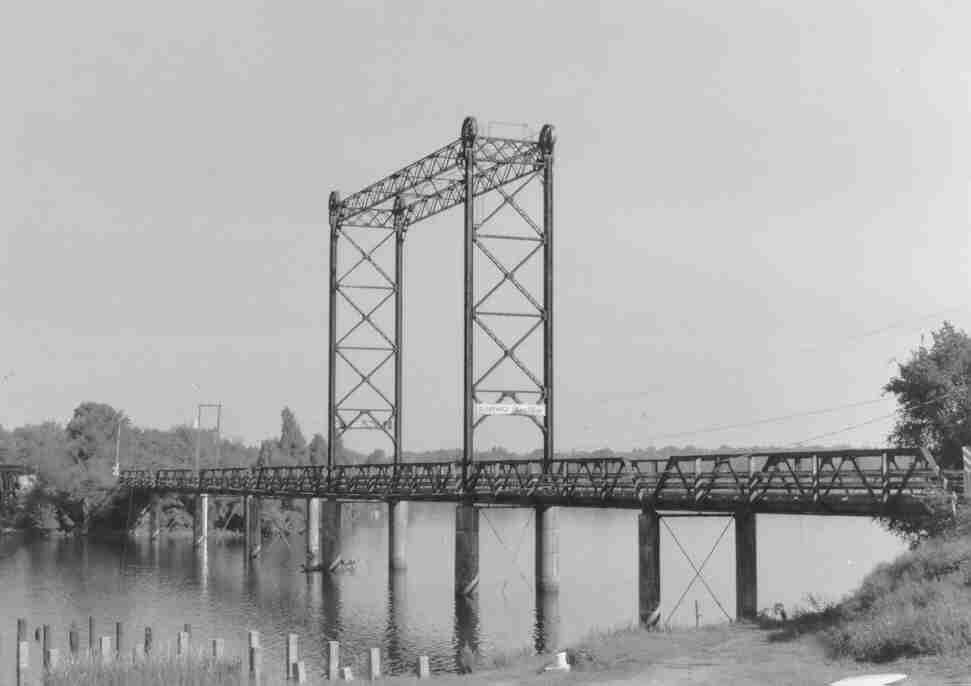
Caddo Lake Bridge (1914) is a vertical lift single lane vehicular bridge
that once carried Louisiana 538 over Caddo Lake at the small community
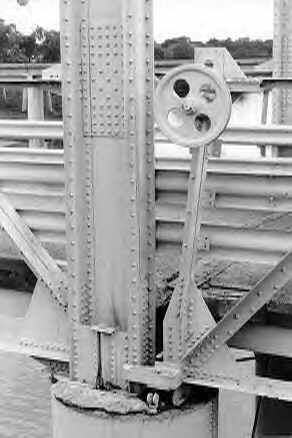
of Mooringsport. The bridge is constructed of riveted L shaped steel members.
Despite the loss of certain elements of the lifting mechanisms, the bridge
easily conveys its historic appearance. The 575-foot bridge traverses
Caddo Lake in a generally north-south direction with a total of seven
spans resting upon concrete piers. The third span from the south shore
is equipped to lift for marine traffic to pass beneath. This span corresponds
to the lake's main channel. All of the spans are of the through truss
type and feature a repetitive pattern of diagonal and vertical braces.
The lift span is slightly wider than the others (95 versus 80 feet) with
a superstructure roughly square in profile.
At each end is a slender tower consisting of a single chord on each side
and diagonal webbing. The towers are braced by a shallow overhead truss
formed of two chords and diagonal webbing. There were two components to
the bridge's lifting capability. One was a system of counterweights and
pulleys that made it easier to lift the span. These worked in a similar
fashion to window sashes with counterweights. The other was a system consisting
of a crank, winches, pulleys and cables that actually lifted the span.
The counterweight system worked as follows:Cables ascending from an eye
in each corner of the lift span were threaded though four massive pulleys
at the top of the towers. These were attached to a pair of coffin-shaped
counterweights. This system, which made it possible to elevate the span
with a relatively small amount of force, survives with the exception of
the counterweights. The lifting mechanism worked as follows: When a boat
approached, the bridge keeper operated a massive manual crank that was
connected to a system of gears in the center of the span. As the keeper
cranked, he ascended with the span. The gear system was connected to a
pair of winches, one on each side of the span's center. These in turn
were connected with cables that fitted through massive pulleys at the
cages of the span and ascended to the top of the towers. One assumes that
the cables fed through a second set of pulleys at the top of the towers.
Assessment of Integrity
To recapitulate, the following elements of the bridge no longer survive:
the manual crank device, the cables, the counterweights, and presumably
a second set of pulleys at the top of the towers. Also, originally the
bridge had a wooden deck. It is now asphalt. Finally, highway type guardrails
have been attached to the insides of the through trusses. Despite the
loss of some elements of the actual lifting mechanism, the structure easily
conveys its identity as a vertical lift bridge and retains the overwhelming
majority of its original character defining fabric. As a one-of-a-kind,
very distinctive bridge within Louisiana, it is a strong candidate for
Register listing.
Significant
Date: 1914
Architect/Builder Engineer: Waddell & Harrington
Builder: Midland Bridge Co., Kansas City
Statement of Significance
Criterion C
The Caddo Lake Bridge is of state significance in the area of engineering
as a rare surviving example of a recognized historic bridge type. It is
also of State significance in the area of transportation as it is one
of Louisiana's sole surviving historic steel through truss vertical lift
bridge. It is also of state significance in the area of transportation
as one of Louisiana's very earliest bridges.
A bridge survey prepared by the Louisiana Department of Transportation and Development for the state system reveals that the Caddo Lake Bridge is the only historic example of its type in Louisiana. DOTD's records further demonstrate that there are no other historic examples on the various parish systems. Had it not been for a recent concerted effort by local citizens, the Caddo Lake Bridge would not have survived. Deemed unsafe for further vehicular use, it was slated for removal and a new bridge was to be built. Locals launched a crusade to save the bridge, with the result that it now stands alongside the new bridge and has a secure future. Caddo Parish agreed to accept responsibility for the structure and plans to open it for pedestrian use.
The bridge's significance must also be assessed within the overall history of bridge construction in Louisiana. The use of bridges as the principal form of traversing waterways came to the state comparatively late. Louisiana is not like, for example, an eastern state where one finds a long and rich heritage of bridge construction, including wooden covered bridges, Victorian decorative cast iron bridges, and heavy railroad bridges styled in a manner resembling Roman viaducts. Indeed, Louisiana was dependent upon ferries well into the twentieth century. The great majority of older bridges in the state date from the late 1920s or later. Thus the construction of a bridge over Caddo Lake as early as 1914 should be regarded as a pioneering effort in the state's transportation history.